| Feb 2026 Issue 28 | ||||||
 |
||||||
|


| Research | |
| AI-Enabled Actuation Modeling and Autonomous Navigation of Magnetic Microrobots | |
|
Author: Professor Zhang Li, Mr. JI Xiang, Department of Mechanical and Automation Engineering
Magnetic microrobots offer unprecedented potential in targeted drug delivery, minimally invasive surgery, and biological monitoring, while smaller sizes also bring bigger challenges. When robots shrink to the micrometer or even nanometer scale—about a fraction of a hair's diameter—traditional control methods hit their limits: The hydrodynamic models and collective motion mechanisms in the microcosmic world remain incompletely understood, posing challenges to traditional modeling approaches; even minor environmental disturbances can derail navigation systems; and in-body tracking gets drowned in noise interference. This is where Artificial Intelligence (AI) technology steps in, equipping these “tiny explorers” with intelligent brains to maneuver through complex environments. Specifically, Deep Learning has emerged as an effective tool to address the aforementioned problems. It can uncover hidden patterns in massive datasets, creating more accurate system models for micro-nanorobots and enabling swarms of thousands of these minuscule machines to navigate autonomously in complex environments.
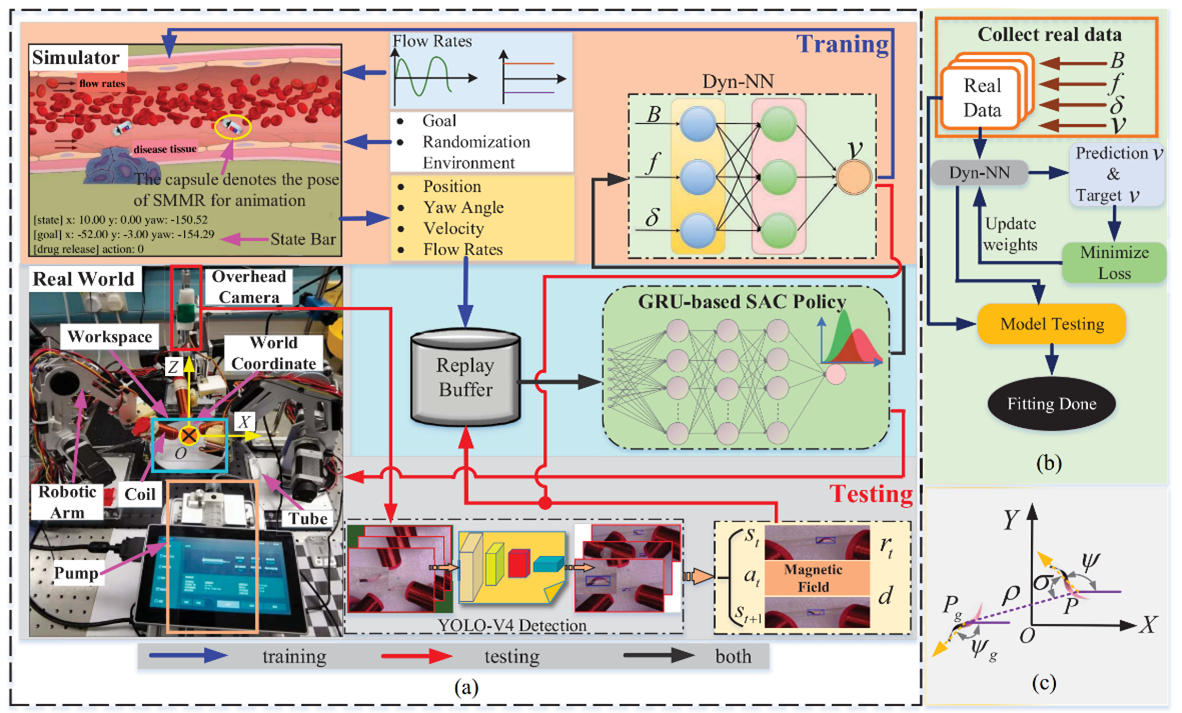
AI offers us a precise physical model of the micro/nano-robotic system that can help us further understand the motion behavior of the robots and improve the control accuracy. As the micro/nano-robots work in a nonlinear and nonuniform magnetic field generated by multiple electromagnetic coils (as shown in Figure 1 [1]), it is impossible to model the system through analytical methods. The currently commonly used method employs the finite element method (FEM) to calculate this complex magnetic field distribution in 3D space. Although this method is versatile, the high computational demands limit its real-time applications. To address these limitations, AI methods have been explored for modeling magnetic actuation systems. For system modeling and simulation of micro/nano-robot behavior, a Dyn-NN model (Fig. 1b) was constructed and trained using experimental data. Through self-supervised training on real-world data, neural networks can directly simulate the motion behavior of micro/nano-robots in complex nonlinear environments without requiring a comprehensive understanding of the entire system. With a radically higher computational efficiency than traditional ones, the AI-based system models lay the foundation for subsequent real-time control strategy design. AI-driven modeling of complex systems differs significantly from traditional methods: instead of solving numerous system equations, it enables future behavior prediction through parameter fitting. This allows us to observe complex micro-system behaviors from a novel perspective and understand their underlying mechanisms.
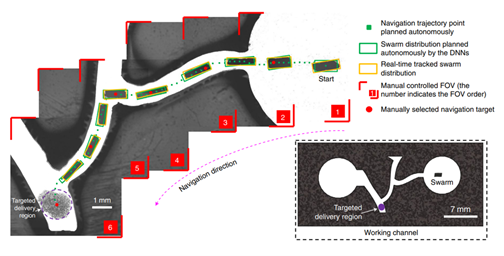
With accurate system models in place, the next step is commanding these microrobot armies to execute tasks: Applying specific magnetic fields drives microrobots to achieve precise navigation in complex environments such as the vascular network. Traditional control methods resemble teaching robots rigid choreography—stiff movements that collapse when environments change. Deep Learning, however, endows them with remarkable adaptability. By training deep neural networks on data from various environmental conditions and task requirements, microrobot swarms can learn optimal distribution strategies (as shown in Fig.2 [2]). These networks can process real-time sensory information from the environment, such as temperature changes, chemical gradients, and obstacle positions, and adjust the swarm’s motion and distribution accordingly. Moreover, Reinforcement Learning serves as a powerful tool for enabling autonomous decision-making in microrobots operating within complex dynamic environments, such as the internal cavities of organisms. It can rapidly optimize microrobots’ coordination strategies through trial-and-error, thereby breaking through the limitations of traditional pre-programmed control.
In the future, the integration of AI with various new medical devices and systems is expected to drive microrobots to make the leap from laboratory demonstrations to clinical applications in fields like precision medicine and micro-manufacturing.
References:
[1] M. Cai et al., Deep Reinforcement Learning Framework-Based Flow Rate Rejection Control of Soft Magnetic Miniature Robots, in IEEE Transactions on Cybernetics, vol. 53, no. 12, pp. 7699-7711, Dec. 2023, doi: 10.1109/TCYB.2022.3199213.
[2] Yang, L., Jiang, J., Gao, X. et al. Autonomous environment-adaptive microrobot swarm navigation enabled by deep learning-based real-time distribution planning. Nat Mach Intell 4, 480–493 (2022).
|
|
 |
|
|
|
|||||||||||||||||||||||


